Reading Antibody Product Records: A Practical Guide
Learn how to interpret antibody product records, distinguish stated catalogue fields from missing validation context, and prepare focused documentation questions.

Reading Antibody Product Records: A Practical Guide
Research record literacy
Reading Antibody Product Records: A Practical Guide
Learn how to read target, host, format, stated application, reactivity and documentation fields carefully—separating information directly shown in a catalogue record from questions that require further review.
Browse antibodies and immunostainingTechnical reading guide
Reading Antibody Product Records: A Practical Guide
Learn how to read target, host, format, application, reactivity, variant and documentation fields without treating catalogue language as proof of validation or workflow performance.
An antibody catalogue record is a useful starting point for research planning, but it is a bounded technical document. It may identify the intended target, describe a reagent format, list applications, show package options and point toward supporting documents. It rarely answers every question needed to select, purchase or use a reagent in a particular laboratory workflow.
The practical skill is not extracting a simple yes-or-no answer from a record. It is separating what is directly stated from what is not shown and from what needs confirmation. That distinction matters when researchers and laboratory purchasers compare records for immunostaining or adjacent research workflows.
This guide presents a repeatable method for reviewing records. It does not select a product, establish suitability or replace current supplier documentation, technical discussion, laboratory controls or workflow validation. Instead, it helps you create a defensible account of the information available and the questions that remain open.
Record boundariesIdentity and namingHost, format and clonalityApplications and reactivityVariants and documentationEvidence mapWorked comparisonWorkflow planningChecklistCommon questions01 / Start with the boundary
The product record is a bounded information source
A catalogue record usually combines several information types: a product name, target description, catalogue identifier, reagent format, stated applications, package options and links to technical material. These fields are valuable because they establish a common vocabulary for a purchasing or research conversation. They are not necessarily a complete account of every condition behind each statement.
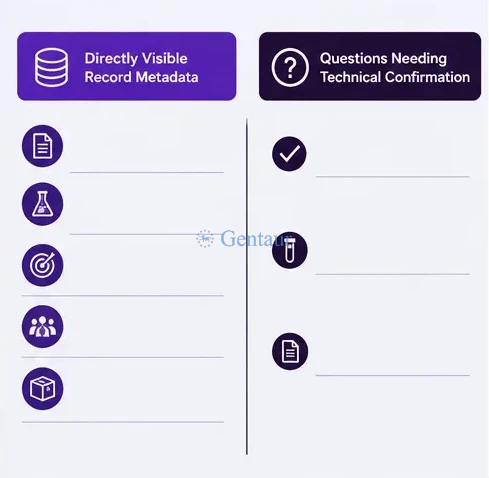
Read every important line as a statement with a defined scope. A field may tell you what the supplier has chosen to describe, but not every condition behind that description. An application label may indicate that an application is listed; it does not automatically describe the sample preparation, detection system, controls, imaging conditions or acceptance criteria involved. A target name may identify the intended biological entity; it does not resolve every issue involving isoforms, fragments, homologues or species-specific sequence differences.
Working rule: classify each decision-relevant statement as stated, not shown or verify. Never convert an absent field into a positive assumption.Three levels of reading
The record explicitly names or describes the field. Preserve its wording, qualifiers and scope.
The record does not present a detail you need. Leave it unknown rather than filling it with an expected value.
The detail could affect planning and should be checked in current documentation or through an appropriate technical inquiry.
This classification is more useful than treating the record as a scorecard. A longer description is not automatically stronger evidence, and a short description is not automatically unsuitable. The relevant question is whether the information visible in the record is sufficient for the decision currently being made and whether unresolved points can be investigated.
Why catalogue language needs context
Catalogue records are designed for discovery as well as technical communication. They allow a reader to locate products by target, application, species, format or other terms. Search-friendly labels can be helpful, but concise labels necessarily compress detail. A phrase that helps a record appear in an application search may not describe the full sample, protocol or evidence context.
Separate three questions whenever you read a record. First, what does the page explicitly say? Second, what would a reasonable reader be tempted to infer? Third, what information would be needed to support that inference? The second question exposes overreading; the third turns uncertainty into an actionable review task.
Use the record for the decision it can support
A record may support early discovery, terminology matching, variant identification, procurement preparation or a request for technical clarification. It may not support a conclusion about performance in an unlisted sample or a guarantee that a workflow will produce a particular result. Match the strength of your conclusion to the strength and scope of the information available.
02 / Identify what the record refers to
Target identity and product naming
Begin with identity before reading application claims. Interpret the exact product entry, not merely a search result, family page or familiar phrase. Capture the displayed product name, target name and descriptive qualifiers. If a record uses a gene symbol, protein name, protein-family term or disease-associated label, preserve that wording rather than silently normalizing it.
What the target field can tell you
The target field can indicate the intended analyte or biological entity described by the supplier. It can help you decide whether a record is broadly relevant to a research question and whether two records appear to concern the same named target. It may reveal qualifiers such as a subunit, fusion product, fragment or other descriptor when those qualifiers are explicitly supplied.
Use the displayed wording to build a search vocabulary, but do not assume that similar names represent identical molecular entities. A symbol, abbreviation and full name may refer to related concepts without resolving isoforms, processing states or sequence boundaries. If the target is central to the experiment, compare the record with current technical documentation and with the nomenclature used in the research plan.
What the target field cannot establish
A target name alone does not establish which epitope is recognized, whether all isoforms are detected, whether a homologue is recognized or whether a reagent distinguishes a modified from an unmodified form. It does not establish target abundance, localization or biological significance in a particular sample. It does not prove that a named target is appropriate for a tissue, cell preparation or assay format.
Do not infer host, clonality, format or application from a target name. Those are separate fields. Do not infer that two records are interchangeable merely because their target labels look similar. Similar nomenclature is a reason to compare qualifiers, not a substitute for doing so.
Follow-up questions for identity
- What exact target description and qualifiers appear in the current record?
- Is an epitope, immunogen, region, isoform or sequence detail documented?
- Are homologues, related proteins or post-translational forms discussed?
- Does the technical document use the same nomenclature as the catalogue page?
- Does the target wording apply to this exact product variant or to a broader product family?
Product names, catalogue records and version control
Product naming is operationally important because search pages, package variants and technical documents may present related information in different places. Record the exact displayed name and the date or version of the document when available. If an entry has multiple pack sizes, formulations, formats or conjugates, make sure the technical information you read applies to the same variant under consideration.
A product name tells you how the supplier organizes the entry. It cannot establish that every package, conjugate or formulation shares the same characteristics. A family page may group records for convenience while variant-specific information remains separate. Treat a variant selector, application table or downloadable document as part of the identity check.
Follow-up prompt: “Does the documentation I am reading apply to this exact record and variant, or only to a related entry?”Do not collapse related records too early
Two records can share a target and still require separate review because they differ in host, format, conjugation, formulation, pack, documentation or stated use. Conversely, two visibly different package options may belong to one technical record. The record structure itself is evidence about how the supplier distinguishes products, but it is not proof that related entries are technically equivalent.
03 / Read molecular and biological fields separately
Host, format and clonality answer different questions
Host, format and clonality are often displayed near one another, but they describe different aspects of a reagent. Read each field independently and avoid using one as a proxy for another.
Host: what it may tell you
When explicitly supplied, host identifies the organism in which the antibody or antibody-producing material is described as having been generated. That information can be relevant to secondary-reagent planning and to interpretation of background considerations in some workflows. It may also help distinguish otherwise similar records.
Host does not, by itself, establish specificity, affinity, cross-reactivity, purity, compatibility with a detection system or performance in a sample. It does not tell you which secondary reagent is appropriate unless the full primary-reagent and detection context is also known. Do not infer host from a familiar clone name, target name, product family or image.
Ask whether the host field applies to the exact variant, whether an unusual host or engineered format is documented and what detection consequences the stated host creates for the planned workflow.
Format: what it may tell you
Format may describe a reagent class or presentation, such as an unconjugated antibody, a conjugated reagent, a fragment or another explicitly named form. Use the record’s terminology. Format can affect how a reagent fits into a detection plan, what additional reagents may be needed and which documents should be reviewed.
Format does not establish compatibility with a particular instrument, fixation method, amplification system or multiplex design. A label that sounds operationally convenient does not remove the need to check fluorophore, enzyme, species, channel, chemistry or sample-specific constraints when those details matter.
Clonality and related descriptors
If clonality or a related descriptor is explicitly stated, record it as supplied. It can be useful when comparing how a reagent was generated or described. It does not by itself prove stronger specificity, broader recognition or superior performance. Those conclusions require evidence appropriate to the question and should not be inferred from the label alone.
| Field | May tell you | Does not establish on its own | Useful follow-up |
|---|---|---|---|
| Host | The stated production host or host description. | Specificity, secondary compatibility or workflow performance. | Confirm exact variant and detection implications. |
| Format | The stated molecular or conjugation presentation. | Compatibility with a particular sample, instrument or chemistry. | Review format-specific technical notes. |
| Clonality | The stated clonality or related descriptor. | Relative quality, affinity or suitability. | Ask what evidence is relevant to the intended decision. |
Separate molecular identity from workflow compatibility
A record can identify what a reagent is without showing how it behaves in a planned workflow. Molecular identity questions concern the target, binding description, host, format and related fields. Workflow questions concern sample preparation, accessibility, detection, controls, imaging and interpretation. The two groups interact, but a clear answer in one group does not answer the other.
For example, knowing that a record lists an unconjugated format may tell you that a separate detection strategy needs consideration. It does not prescribe a secondary reagent, establish a suitable channel or prove that the planned sample preparation will preserve the relevant signal. Treat the format as an input to planning, not as a completed plan.
04 / Interpret use claims carefully
Stated applications are signals for review, not automatic validation
Application labels are among the most useful and most easily overread fields in a catalogue record. They can tell you which uses the supplier has chosen to list and may direct you toward relevant technical notes or examples. They do not, without further context, establish that every sample type, preparation method, detection system or laboratory will obtain the same result.
What an application label can tell you
A stated application can help classify the record and prioritize documentation review. An immunostaining label signals that the record should be examined for sample preparation, detection, control and imaging information relevant to that use. An ELISA-related label can prompt review of assay format, matrix, standards, controls and readout details. The label is a route into the evidence, not the evidence in its entirety.
Capture qualifiers exactly. “Tested application,” “recommended use,” “suitable for,” “reported use” and similar phrases may have different meanings within a supplier’s documentation. Do not remove qualifying words when transferring information into a purchasing comparison. A shortened label can appear stronger than the original statement.
What an application label cannot establish
An application label does not prove validation in your sample, protocol or instrument. It does not prove that the reagent will produce a particular signal, background level, dynamic range or image quality. It does not supply missing information about fixation, permeabilization, blocking, dilution, incubation, antigen retrieval, secondary detection or controls.
It also does not justify importing an application from a related product. A record for one format, conjugate or target variant should not be treated as evidence for another unless the documentation explicitly connects them. Similarly, a use reported in one sample context should not automatically be extended to another.
Species, sample and reactivity fields
When a record lists species, sample types or reactivity, treat each as a defined statement. A species field may refer to the source of the sample, the species reactivity claimed by the supplier or another context; determine which from the surrounding documentation. A reactivity statement may describe the scope presented in the record, but it does not automatically resolve all tissues, cell states, homologues or sample-preparation conditions.
Copy directly stated information accurately. Keep information that is not shown unfilled. If the intended sample is outside the listed context, formulate a question rather than extending the claim. Ask whether the relevant species, tissue, cell type, fixation or preparation has been documented for the exact product variant.
Conjugation and detection-related fields
Discuss conjugation or detection information only when it is documented. If the record names a fluorophore, enzyme, tag or other detection-related feature, note the exact feature and its variant association. This may inform channel planning, secondary-reagent needs or instrument-compatibility questions.
Do not infer a conjugate from product imagery, a color name, a nearby product or the availability of a related conjugated version. A named detection feature does not establish brightness, stability, signal-to-background behavior or compatibility with every imaging setup. Those are separate technical questions.
Research context: Immunostaining decisions are application-specific. Sample preparation can alter accessibility; detection chemistry can introduce its own compatibility requirements; controls help distinguish target-related signal from background or process effects. A catalogue label cannot substitute for reviewing these dependencies.Application evidence has a scope
When supporting material is available, identify what the material actually demonstrates. A protocol may describe one set of conditions. A representative image may illustrate one context. A technical note may summarize an application without exposing every control or acceptance criterion. A statement that testing occurred is not the same as a complete transferable protocol.
Ask four scope questions: What sample or material was examined? What preparation and detection conditions were used? What controls or comparisons were included? Which part of the conclusion is directly documented? If the answer to one of these questions is unavailable, record the gap rather than silently filling it.
05 / Inspect operational details
Pack sizes, variants, storage and handling
Pack and variant information is purchasing detail, but it can affect planning and documentation. Record the stated pack size, concentration or amount only when supplied; formulation or buffer description when supplied; and any variant label that distinguishes one entry from another. If price or availability is shown, record the date or context because those values can change and do not describe product performance.
What these fields can tell you
Pack information can support a quantity calculation and help compare the operational scope of variants. Storage and handling information can establish the conditions the supplier has documented for the product. A formulation field can alert you to the presence of a stated buffer or preservative and prompt compatibility review where the workflow is sensitive to such components.
What these fields cannot establish
A larger pack does not establish better value for an experiment, and a smaller pack does not establish lower quality. A storage statement does not prove that a product retained a particular property after every handling history. A listed formulation does not establish compatibility with every downstream reagent, surface or assay condition.
Variant matching is a documentation task
When comparing variants, create a separate row for each decision-relevant difference. Note whether the difference is package size, concentration, conjugation, formulation, host, format or another stated attribute. Then match each row to the document that supports it. Do not use information from the most detailed variant to fill gaps in a less detailed variant unless the documentation explicitly says the information applies across the group.
- Does the amount or concentration apply to the exact variant selected?
- Are storage, freeze-thaw and handling instructions available in the current technical document?
- Are formulation components relevant to the planned workflow?
- Is price or availability being used only for procurement planning rather than as evidence of technical quality?
- Are all records being compared at the same level of package and format detail?
Documentation and missing context
Documentation review is where a short catalogue record becomes a more useful technical conversation. Look for datasheets, protocols, validation notes, application images, frequently asked questions and variant-specific instructions when available. Treat each document according to what it contains. A protocol may describe one condition set; an image may illustrate one context; a datasheet may summarize fields without resolving every application question.
Build a missing-context list while reading. Common gaps include sample preparation, fixation, antigen retrieval, detection chemistry, controls, dilution, incubation, imaging conditions, species scope, reactivity limits, lot or variant distinctions and the basis for an application label. A gap is not automatically a negative finding. It is a signal that the decision should not rest on an assumption.
Good inquiry language: “The record lists the application, but I could not find the sample-preparation and detection context for our intended use. Which current document addresses those conditions, and which points should we treat as unresolved?”Read documents in layers
Start with the catalogue page to identify the exact entry and visible fields. Next, review the technical document that appears to apply to that entry. Then compare any application-specific material with the intended sample and workflow. Finally, record discrepancies between documents rather than choosing the statement that is most convenient.
When documents use different names, dates or variant descriptions, preserve the discrepancy in your notes. It may be a harmless presentation difference, or it may indicate that the documents have different scope. The record reader’s task is not to resolve a technical discrepancy by guesswork.
Missing context is a question, not a verdict
It is tempting to treat a missing field as evidence that an application is unsupported, or to treat a familiar convention as evidence that the field must be covered. Both responses overreach. “Not shown” means only that the information was not visible in the material reviewed. The appropriate next action may be to find a current document, consult technical support or reconsider whether the unresolved point is essential to the decision.
Prioritize gaps according to their effect on the planned decision. If detection compatibility is a prerequisite, resolve that before comparing package sizes. If the question concerns a particular species, resolve the scope of the reactivity statement before treating records as comparable. A structured priority order prevents minor procurement details from distracting from major workflow uncertainties.
06 / Make the unknowns visible
Build an evidence map before making a shortlist
An evidence map turns passive reading into a reproducible review. Use one row per decision-relevant field. In the directly stated column, quote or summarize only what the record says. In the interpretation-limit column, write the conclusion you must not draw. In the follow-up column, specify the document or question that would reduce uncertainty.
| Record field | Directly stated information | Interpretation limit | Follow-up documentation need |
|---|---|---|---|
| Target | Stated, if listed. | Does not resolve every isoform, epitope or homologue question. | Review target qualifiers, sequence or epitope information if relevant. |
| Host | Stated, if listed. | Does not prove specificity or secondary compatibility. | Confirm exact variant and detection implications. |
| Format | Stated, if listed. | Does not prove compatibility with a planned workflow. | Review format-specific technical notes. |
| Stated application | Application label and qualifiers. | Does not prove validation in the reader’s sample or protocol. | Review supporting documentation and conditions. |
| Species or reactivity | Stated scope, if listed. | Does not justify extension to unlisted contexts. | Confirm intended species, tissue and preparation. |
| Validation context | Documented, not shown or unclear. | Absent detail cannot be treated as successful validation. | Locate relevant current evidence or ask a focused question. |
| Protocol detail | Documented, partial or not shown. | A label cannot supply missing conditions. | Review sample, detection, controls and readout details. |
| Storage or handling | Stated instructions, if present. | Does not establish every post-opening outcome. | Use current handling documentation. |
| Variant data | Pack, conjugate or formulation fields. | Related variants are not automatically equivalent. | Match documents to the exact variant. |
Use neutral statuses
Use statuses such as stated, not shown and verify. Avoid a scoring system that makes unknown information look like poor performance or rewards the longest description. The map is a decision aid: it shows where a conclusion is supported and where the next action is document review or inquiry.
Keep the evidence map close to the record rather than rewriting it as a conclusion. If a field changes, the map should make it possible to identify which planning statement also needs review. This is particularly important when several people participate in purchasing, technical review and workflow planning.
Distinguish evidence quality from information volume
A record with many fields may still leave a central question unresolved. A shorter record may clearly identify the few facts needed for an early procurement step while leaving later application questions for discussion. Do not equate more text with more validation. Instead, ask whether the information is relevant, specific to the exact variant and connected to the decision being made.
07 / Apply the method
Generic worked example: compare profiles without declaring a winner
Consider two hypothetical records, Profile A and Profile B. Neither profile represents a real product, and no product fact should be inferred from the example. The purpose is to demonstrate how to compare information visibility and unresolved questions without calling either profile superior.
| Field | Profile A | Profile B | Appropriate reading |
|---|---|---|---|
| Target | Named target with a qualifier. | Named target without the qualifier shown for A. | Confirm whether the wording describes the same molecular scope. |
| Host | Listed. | Not shown. | A host is visible for A; B requires confirmation. This does not rank specificity. |
| Format | Listed as an unconjugated format. | Format field is present but requires variant review. | Compare exact entries before planning detection. |
| Application | Immunostaining label shown. | Immunostaining label shown with different qualifiers. | Review wording and supporting conditions; neither label proves suitability. |
| Reactivity | Species scope not shown in the summary. | Species scope is listed. | Check full documentation and intended sample context. |
| Protocol | Sample preparation not shown. | Detection context not shown. | Each profile has a different unresolved workflow dependency. |
| Variant | Two pack options displayed. | One pack option displayed. | Compare quantity and procurement needs separately from technical claims. |
Step one: normalize the question
Define the target, sample context and intended readout before deciding which fields matter most. A record comparison is only meaningful relative to a decision. If the immediate question is whether the exact target is represented, identity fields lead. If the question is how a reagent might enter an immunostaining plan, format, detection and sample-context fields become more important.
Step two: preserve the record wording
Copy application qualifiers and target descriptors rather than simplifying them. “Immunostaining” and “immunostaining with a specified context” are not necessarily equivalent statements. A qualifier may narrow a claim or identify the evidence context. Removing it can make the comparison appear more decisive than the source material supports.
Step three: separate visibility from confidence
A field shown in A is not automatically stronger evidence than a field shown in B; it may simply be documented differently. A visible application label remains an application label. A missing host remains unknown. Neither fact should be converted into a broad judgment about product performance.
Step four: identify the blocking unknown
If detection compatibility is central, the missing detection context may need attention before pack size or price. If the intended sample is outside the listed species scope, that issue may be more important than whether two records offer the same package amount. Prioritize the unknown that could change the decision.
Step five: ask a focused question
Request the specific document or clarification needed rather than asking whether the product “works.” A focused question identifies the exact record, variant, intended sample context and missing field. It gives the response a defined scope and makes it easier to record the answer accurately.
Step six: record the response
Date the document or inquiry response and associate it with the exact record and variant reviewed. If the response addresses only one condition, do not generalize it to every sample or application. The result is a transparent account of what each profile contributes to planning and what remains unresolved.
This comparison does not produce a universal ranking. A later decision may depend on sample access, controls, budget, availability, instrument constraints or other factors outside the catalogue fields. The value of the method is that those dependencies remain visible.
08 / Move from record to planning
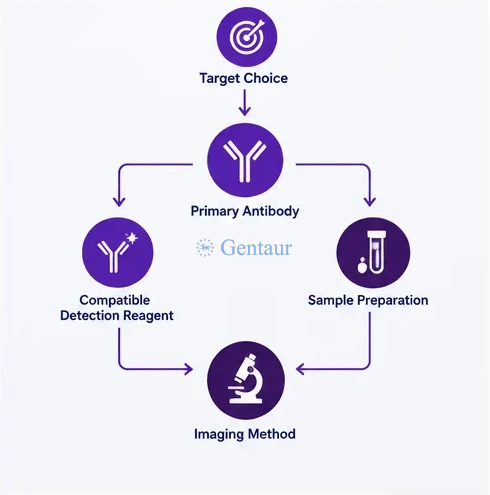
Use record review to plan an immunostaining conversation
Record literacy is useful when it changes the questions asked before a workflow is assembled. It should not be turned into a universal protocol. The sequence below connects record review to planning while preserving application-specific boundaries.
Define target and sample context
State what is being investigated, in which sample context and with what intended readout.
Review the primary reagent record
Capture target, host, format, stated use, species or reactivity and variant fields exactly as documented.
Assess the detection strategy
Check whether the primary format and documented conjugation details fit the planned detection conversation.
Plan controls
Identify controls appropriate to the research question. The record cannot prescribe them for every sample or laboratory.
Check compatibility
Review sample preparation, detection chemistry, instrumentation and other application-specific dependencies.
Record unresolved questions
Mark missing information as not shown and seek current documentation or a focused technical response.
Define the sample context before interpreting the application
“Immunostaining” is not one uniform condition. The relevant context may include the source material, preservation or fixation approach, section or preparation type, target accessibility, detection design, imaging method and controls. A record may mention one of these elements, several or none. Without the context, a broad application label cannot answer whether the planned workflow is covered.
Review primary and detection components together
A primary reagent record can inform detection planning, but it does not by itself complete the detection strategy. An unconjugated format may raise questions about a secondary reagent; a documented conjugate may raise questions about channel, instrument and sample context. These are planning prompts, not automatic instructions.
Plan controls as a separate decision
Controls depend on the research question and workflow. A catalogue record may mention controls in a document, or it may not. Do not infer that the absence of a control description means that no control is needed, and do not infer a universal control set from an application label. Record which control questions require discussion in the laboratory.
Example of a useful inquiry
Suppose a record lists immunostaining but does not show whether the stated context involved the fixation and detection approach planned by a laboratory. A useful inquiry would identify the target, exact record and intended sample context, then ask which documentation addresses preparation and detection conditions. It would not ask for a guarantee of an image or assume that a listed application transfers unchanged to the planned workflow.
Sample preparation, detection chemistry, controls and compatibility are application-specific. Discuss them as linked planning questions, not as consequences that can be read directly from a target name or application badge.
When a record is sufficient for one step but not another
A record may be sufficient to decide that a product belongs in an initial discovery set. It may be sufficient to identify a variant that needs a current price or availability check. It may not be sufficient to finalize a workflow. Make this step-specific judgment explicit. “Sufficient for shortlist review” is different from “sufficient to establish workflow suitability.”
09 / Keep the review consistent
Antibody record-reading checklist
Use this checklist when reviewing one record or several records side by side. Write documented, not listed or needs confirmation beside each item. Blank-safe labels preserve uncertainty without inviting invented data.
Identity
- Target wording: documented / not listed / needs confirmation
- Qualifiers, isoform or region: documented / not listed / needs confirmation
- Exact record and variant: documented / not listed / needs confirmation
- Nomenclature matched to the research question: documented / not listed / needs confirmation
- Relevant target ambiguity recorded: documented / not listed / needs confirmation
Stated use
- Application label and qualifiers: documented / not listed / needs confirmation
- Species, sample or reactivity scope: documented / not listed / needs confirmation
- Validation context: documented / not listed / needs confirmation
- Protocol conditions: documented / not listed / needs confirmation
- Evidence scope preserved: documented / not listed / needs confirmation
Format and variant
- Host: documented / not listed / needs confirmation
- Format or clonality: documented / not listed / needs confirmation
- Conjugation or detection feature: documented / not listed / needs confirmation
- Pack, amount or formulation: documented / not listed / needs confirmation
- Variant-specific document matched: documented / not listed / needs confirmation
Workflow questions
- Sample preparation and fixation: documented / not listed / needs confirmation
- Detection chemistry and instrument context: documented / not listed / needs confirmation
- Controls and interpretation context: documented / not listed / needs confirmation
- Storage and handling: documented / not listed / needs confirmation
- Unresolved compatibility issue prioritized: documented / not listed / needs confirmation
Inquiry preparation
- Exact question identified: documented / not listed / needs confirmation
- Relevant record and variant captured: documented / not listed / needs confirmation
- Missing document or field named: documented / not listed / needs confirmation
- Intended sample context described: documented / not listed / needs confirmation
- Response can be linked back to the record: documented / not listed / needs confirmation
How to use the checklist in a group
Agree on the meaning of each status before several people review records. One reviewer may use “documented” for a brief application label, while another may reserve it for a detailed protocol. Both can be reasonable if the team defines the distinction. A useful practice is to reserve “documented” for information visibly present, use “not listed” when it was not found in the reviewed material and use “needs confirmation” when the information could affect the decision but its scope or currency is uncertain.
Keep quotations or source notes beside important checklist entries. The checklist is a summary, not a replacement for the record. If a later reviewer cannot tell why an item received a status, the summary has become too detached from its source.
10 / Use terms precisely
Compact glossary
- Application label
- A use category or claim explicitly displayed in a product record. It is not, by itself, proof of validation in every sample or protocol.
- Format
- The explicitly stated molecular or presentation form of a reagent, such as a conjugated or unconjugated form when documented.
- Host
- The production host or host description stated in the record. It should not be used as a proxy for specificity or performance.
- Reactivity
- The species or other scope described by the record. Its exact meaning should be read from associated documentation.
- Variant
- A distinct package, formulation, conjugate, amount or other record option that may require variant-specific documentation.
- Validation context
- The sample, preparation, detection, controls and other conditions associated with documented testing. A label alone does not supply this context.
- Evidence map
- A structured table separating directly stated information, interpretation limits and follow-up documentation needs.
- Not shown
- A neutral status indicating that a detail was not visible in the material reviewed. It is not a positive or negative performance judgment.
- Follow-up question
- A focused request for a document or clarification that addresses a defined unresolved field.
11 / Clarify the conclusion
Common questions about reading antibody records
Does an application label mean the antibody is validated for my workflow?
No. It means the application is listed in the record. Review the associated sample, preparation, detection, controls and other conditions before deciding whether the information addresses your workflow. Suitability and performance should not be inferred from the label alone.
Can I infer host from the target or clone name?
No. Host is a separate field and should be treated as stated only when explicitly supplied. If the host is not listed, mark it as not shown and confirm it when it affects detection planning.
Does a conjugated format remove the need to review detection compatibility?
No. A documented conjugate may reduce some planning questions, but channel, instrument, sample preparation, controls and other compatibility issues remain application-specific.
How should I compare two records with different amounts of information?
Compare fields individually and preserve the scope of each statement. More visible fields do not automatically establish better performance. Identify which missing fields could change the current decision and prioritize those for review.
What should I do when species or reactivity information is missing?
Do not extend the record to an unlisted species or sample. Mark the field as not shown, review current documentation and ask a focused question that names the intended sample context and exact variant.
Can package size or price help me select a technically suitable record?
Package size and price support procurement planning. They do not establish specificity, validation, compatibility or performance. Keep operational comparisons separate from technical conclusions.
What makes a good technical inquiry?
A good inquiry identifies the exact record and variant, describes the intended sample or workflow context, names the missing field and asks which current document or clarification addresses it. Avoid asking for an unqualified guarantee that a product will work.
Conclusion
Read less into a record—and ask better questions
A careful product-record review makes the decision boundary visible. Start with target identity and exact naming. Read host, format, clonality, application, reactivity, detection and variant fields independently. Preserve qualifiers. Mark missing information as not shown. Then connect unresolved points to current documentation and focused inquiry.
This approach supports consistent comparisons without implying that catalogue metadata proves application suitability or performance. It also creates a useful handoff between purchasing, technical support and the research team: everyone can see which statements came from the record, which conclusions were intentionally avoided and which questions remain open.
The objective is not to make a catalogue record carry more authority than it has. The objective is to use its visible information carefully, recognize its limits and move the next decision to the right source of evidence.
Record-reading tool
Separate stated metadata from unresolved evidence
Use this map while reviewing an antibody catalogue record. Record only what the source explicitly states, then identify the conclusion it does not support and the documentation or inquiry needed before a workflow decision.
| Record field | Directly stated information | Interpretation limit | Follow-up documentation need |
|---|---|---|---|
| Target identityStated | Target name, antigen description, gene or protein designation, and any stated synonym exactly as presented in the record. | A name alone does not establish that the reagent recognizes every isoform, modification, fragment, ortholog, or sample-specific form of the target. | Verify the target definition, antigen region or immunogen description, recognized form, and any cross-reactivity information in the technical documentation. |
| Product namingStated | Catalogue title, clone or designation when supplied, and the naming conventions used for the record and its variants. | Similar names do not prove that two records are the same reagent or interchangeable products. A shared target label may conceal differences in clone, host, conjugate, or formulation. | Compare the complete record identifiers, clone or designation, format, conjugation, size, and technical documents rather than relying on the short title. |
| HostStated | The host species or host system listed for the antibody, if the record supplies it. | Host information does not by itself establish compatibility with a secondary reagent, endogenous immunoglobulin background, tissue type, or detection system. | Confirm secondary-reagent compatibility, endogenous-background considerations, and any species-specific guidance relevant to the planned application. |
| Format and clonalityVerify | Monoclonal or polyclonal designation, clone name, recombinant description, fragment or whole-antibody format, when explicitly documented. | These labels do not alone establish epitope recognition, lot-to-lot behavior, affinity, selectivity, or suitability for a particular assay. | Review the stated format definition, clone information, production description, lot or batch notes, and application-specific validation material. |
| Stated applicationStated | Applications listed by the supplier, such as immunostaining or ELISA, including any qualifiers or tested-use notes shown in the record. | An application label is not proof of validation for every sample type, fixation method, instrument, protocol, or experimental objective. It is not a guarantee of performance. | Read the application-specific datasheet, protocols, validation figures or notes, sample conditions, controls, and any limitations before treating the application as relevant to the planned work. |
| Species or reactivityVerify | Species tested, species recognized, reactivity claims, or other species-related fields only when they are explicitly listed. | Absence of a species entry is not evidence of reactivity, and a listed species does not define performance across tissues, preparations, or related species. | Confirm whether the statement refers to tested reactivity, predicted homology, or another basis; request supporting documentation for the intended sample context. |
| Conjugation and detectionStated | Fluorophore, enzyme, biotin, carrier, unconjugated status, or other detection-related feature when documented. | A listed label does not establish signal behavior, instrument compatibility, spectral separation, background, or performance after the planned sample preparation. | Check conjugate specifications, detection requirements, excitation or measurement constraints where supplied, compatibility notes, and controls for the intended detection chemistry. |
| Validation contextNot shown | Figures, protocols, sample descriptions, control information, or validation summaries that are actually included with the record. | A product page may omit important context. A citation, image, application badge, or brief statement cannot be treated as a complete validation package. | Locate the full datasheet and application documentation. Record sample type, preparation, controls, conditions, replicate information, and the boundaries of any supplied evidence. |
| Protocol detailVerify | Documented dilution guidance, incubation information, blocking or wash notes, preparation requirements, or other instructions when present. | Protocol details are context-dependent and do not automatically transfer between sample types, instruments, detection systems, or laboratory practices. | Ask which conditions were used to generate the guidance, which steps are essential, what controls are recommended, and which variables remain unspecified. |
| Storage and handlingStated | Storage temperature, light protection, freeze-thaw guidance, reconstitution instructions, stability notes, or handling warnings when supplied. | Storage information does not establish the condition of a particular shipment or guarantee performance after an undocumented handling history. | Follow the current technical instructions and confirm lot-specific, reconstitution, expiration, transport, and handling requirements where relevant. |
| Pack and variant dataStated | Pack size, concentration, volume, conjugate, format, formulation, or other selectable variant information shown in the record. | Different sizes or variants may not be equivalent for formulation, concentration, detection, or documentation. A larger pack is not automatically a better choice. | Compare the exact variant record, units, concentration, formulation, availability, documentation, and workflow quantity assumptions before shortlisting. |
| Unresolved questionsVerify | Fields that are blank, qualified, ambiguous, inconsistent across documents, or absent from the visible record. | Missing information should remain unknown. It must not be completed with assumptions based on a similar product, common laboratory practice, or a related publication. | Create a focused inquiry covering the target form, intended sample, application context, detection strategy, controls, handling, variant, and supporting documentation needed. |
Stated means the record explicitly provides the information. Not shown means the visible record does not provide it. Verify means the field may be present or relevant, but its meaning, scope, or application context requires documentation review. None of these statuses establishes product performance.
Planning framework
Turn catalogue fields into documented questions
Reading an antibody record is one part of immunostaining planning. The record can organize the information already stated by the supplier, but it does not replace review of the complete documentation or application-specific validation. Use the sequence below to separate known information from compatibility questions that still require confirmation.
Define the target and sample context
Begin with the biological question rather than with a product label. Record the target name as it appears in the research plan, then note the sample type, species or model, preparation state and the intended readout. These details establish the context in which later record fields must be interpreted.
Planning question: Which sample and target details must be matched against the product documentation?
Review the primary reagent record
Read the target designation, host, format, clonality or other supplied identity fields together. Capture the exact record wording and distinguish a stated field from an interpretation. If an application is listed, treat it as a description of what the record says—not as proof that the reagent is suitable for every sample, preparation or imaging context.
Planning question: Which relevant fields are directly stated, and which are not shown?
Assess the detection strategy
Map the primary reagent record to the intended detection approach only after checking what is documented. Relevant considerations may include whether the record describes an unconjugated or conjugated format, the detection chemistry being considered, and whether the host or other identity fields create a compatibility question with the planned detection reagents. Do not infer conjugation, signal behavior or compatibility when the record does not state it.
Planning question: What detection-related information is documented, and what must be checked in the technical notes?
Plan controls as part of the application
Controls should be considered alongside the sample and detection design, not added as an assumption about the reagent. The appropriate controls depend on the research question, sample preparation, detection chemistry and interpretation criteria. A catalogue record may help identify documented application context, but it does not prescribe a universal control set or establish how a particular workflow will behave.
Planning question: Which controls are needed to distinguish target-related signal from preparation, detection or background effects in this specific design?
Check documentation and compatibility
Review the available technical documentation for sample context, species or reactivity information, protocol notes, storage or handling information, format details and any stated limitations. Compatibility is application-specific: sample preparation, detection chemistry, controls and other workflow conditions may affect what must be confirmed. Keep a separate list of statements that are documented, information that is not listed and questions that require an authoritative answer.
Planning question: Which unresolved details could change the planned workflow or the way its results are interpreted?
Record unresolved questions before shortlisting
Convert missing fields into precise inquiry questions. This makes comparisons more consistent and avoids treating an incomplete record as if it contained a complete validation history. Keep the question tied to the intended application and ask for documentation rather than asking whether a product “works” in the abstract.
Planning question: What must be confirmed before the record can be compared fairly with another candidate?
Generic example
Turn a missing field into an inquiry
Suppose a hypothetical antibody record states a target name and host but does not show sample context, detection format or species/reactivity information. The appropriate response is not to assume that the omitted fields are compatible with a planned immunostaining workflow. Instead, write a focused question such as: “For the sample context and detection strategy under consideration, which species or reactivity information and format details are documented, and where can the supporting technical documentation be reviewed?”
This question preserves the boundary between what the record states and what the researcher still needs to evaluate. A second hypothetical record may contain more fields, but greater completeness alone does not establish performance or make either record superior. The records should be compared against the same application-specific questions and documentation requirements.
Shortlist review tool
A consistent way to compare antibody records
Use this checklist when reviewing several catalogue records for an immunostaining or adjacent research workflow. Mark each item as documented, not listed, or needs confirmation. These labels describe the state of the record—not the quality, suitability, or performance of the product.
01 Identity
- Target name: documented / not listed / needs confirmation
- Aliases or naming context: documented / not listed / needs confirmation
- Target form or region: documented / not listed / needs confirmation
- Species or sample context: documented / not listed / needs confirmation
- Record-to-record naming consistency: documented / not listed / needs confirmation
02 Stated use
- Application label: documented / not listed / needs confirmation
- Species or reactivity statement: documented / not listed / needs confirmation
- Sample or tissue context: documented / not listed / needs confirmation
- Protocol or technical-note reference: documented / not listed / needs confirmation
- Validation context and boundaries: documented / not listed / needs confirmation
An application label identifies a stated use; it does not, by itself, establish validation or suitability for a particular workflow.
03 Format and variant
- Host: documented / not listed / needs confirmation
- Clonality or reagent type: documented / not listed / needs confirmation
- Format: documented / not listed / needs confirmation
- Conjugation or detection-related field: documented / not listed / needs confirmation
- Pack size and available variant: documented / not listed / needs confirmation
04 Documentation
- Technical datasheet or record notes: documented / not listed / needs confirmation
- Storage and handling information: documented / not listed / needs confirmation
- Lot, release, or other record-specific context: documented / not listed / needs confirmation
- Referenced protocol details: documented / not listed / needs confirmation
- Revision or currency of supporting documentation: documented / not listed / needs confirmation
05 Workflow questions
- Sample preparation requirements: documented / not listed / needs confirmation
- Primary reagent and detection strategy compatibility: documented / not listed / needs confirmation
- Controls needed for the planned experiment: documented / not listed / needs confirmation
- Incubation, wash, or visualization details: documented / not listed / needs confirmation
- Application-specific constraints: documented / not listed / needs confirmation
Treat sample preparation, detection chemistry, controls, and compatibility as application-specific questions. Do not fill gaps by assuming that a record applies to a workflow simply because its target or application label appears relevant.
06 Inquiry preparation
- Exact record or product name to discuss: documented / not listed / needs confirmation
- Unresolved field identified: documented / not listed / needs confirmation
- Planned application and sample context summarized: documented / not listed / needs confirmation
- Requested clarification stated as a specific question: documented / not listed / needs confirmation
- Availability, pack, or pricing question separated from technical questions: documented / not listed / needs confirmation
A useful inquiry distinguishes what the record states from what remains unknown. Ask for the missing documentation or clarification directly rather than treating an unlisted field as a negative or positive result.
Antibody Product Record FAQ
Record review / frequently asked questions
Questions to ask before relying on an antibody record
A catalogue record is a bounded technical source: it can organize documented attributes, but it cannot answer every application, compatibility, validation, availability, or purchasing question. Use the questions below to separate what is stated from what still needs confirmation.
01What should I do when the application I need is not listed?
Treat an unlisted application as not shown, not as evidence that the reagent is unsuitable or suitable. First define the intended use precisely: sample type, preparation, detection method, target form, and the controls you expect to use. Then review the full technical documentation for application-specific notes, published examples, or protocol context if those materials are available.
If the documentation does not resolve the question, prepare a focused inquiry. Ask whether information exists for the exact application and sample context, what preparation and detection conditions were documented, and which controls or compatibility checks were used. An application label alone does not establish validation, performance, or suitability for your workflow.
02How should I interpret the host field?
The host field identifies the host associated with the antibody record when that field is explicitly supplied. It is useful when planning a detection strategy and considering possible interactions with sample material or secondary reagents, but it does not by itself establish compatibility with a particular tissue, species, fixation method, or assay format.
Check whether the record distinguishes the host from the immunogen, the target sample species, and the species or reactivity claims. If any of these details are absent, mark them as needs confirmation. Ask which host information is documented, whether the intended detection chemistry has been evaluated in the relevant context, and whether additional controls are recommended.
03What can the format field tell me?
Format describes the form in which the reagent is supplied or identified in the record, when that information is provided. Depending on the record, this may distinguish a preparation, conjugated form, or another product variant. Use the exact wording supplied rather than expanding it into an unstated claim about purity, affinity, stability, or assay behavior.
Format is one input into planning detection and handling. It does not prove that a reagent is interchangeable with another format or that a particular secondary reagent, instrument, or workflow will be compatible. Confirm the detection-related documentation, formulation or handling notes, and any format-specific instructions before making a workflow decision.
04How can I compare two variants without assuming one is better?
Compare variants by documented differences rather than by position, price, package size, or a marketing label alone. Place identity, format, conjugation or detection-related information, pack size, stated applications, handling notes, and available documentation in parallel columns. Mark each field as documented, not listed, or needs confirmation.
A larger pack is not automatically a better fit, and a different format is not automatically equivalent. Ask whether the variants share the same explicitly stated target and record scope, whether the intended use is documented for both, and whether storage or handling information differs. The comparison should reveal questions for review; it should not declare a superior product without supporting evidence.
05Why is documentation review necessary if an application is listed?
An application label is a catalogue statement, not a complete validation report or universal protocol. Documentation may clarify the sample context, preparation, reagent concentration or dilution information, detection method, controls, images or other limitations associated with the statement. Those details determine how much can reasonably be concluded from the record.
Review the technical sheet, datasheet, protocol notes, and any linked supporting material that is actually provided. Record what each source says and what it does not say. If the intended workflow differs from the documented context, treat the difference as an unresolved compatibility question rather than transferring the claim automatically.
06What should I check when planning an immunostaining workflow?
Use the record to organize questions across the workflow: target identity and form, sample preparation, primary reagent format, detection chemistry, controls, and compatibility with the surrounding materials. Sample preparation, detection chemistry, controls, and compatibility are application-specific decisions. A record does not provide a universal immunostaining protocol unless the relevant protocol is explicitly supplied.
Before shortlisting, identify which steps are documented and which require review. For example, if the record states an application but does not describe fixation or detection conditions, ask whether information for the intended sample and detection system is available. Do not claim that the product works in a particular workflow unless that use is directly documented.
07How should I ask about availability or pricing?
Availability and pricing are time-sensitive commercial details. Check the current product record or purchasing surface for the information displayed there, including the relevant variant or pack size. If the record does not show a value or status, label it not listed rather than inferring that the item is unavailable, available, in stock, or interchangeable with another variant.
For a useful inquiry, include the product name as displayed, the relevant variant or pack size, the quantity or timing question, and the specific information you need confirmed. Keep commercial questions separate from technical suitability questions so that each can be answered against the appropriate current documentation.
08What should I include in an inquiry about a record?
Prepare a concise question set before submitting an inquiry. Identify the target as written in the record, the intended application, sample or species context, reagent format, detection strategy, and the exact field that is missing or ambiguous. Ask for documentation rather than a broad assurance—for example, request the conditions or supporting material associated with a stated application.
Useful wording distinguishes facts from assumptions: “The record lists this application, but does not show the sample preparation or detection context. Is documentation available for this specific workflow?” You can also ask whether a selected variant has different handling, pack, or format information. An inquiry can obtain clarification; it does not replace independent workflow review or validation.
“Documented” means the information is explicitly present in the materials you reviewed. “Not listed” means you did not find it there. “Needs confirmation” means the answer matters to your decision but requires further documentation or a direct inquiry. None of these labels, by itself, establishes product performance.